Changing Perceptions on Sight Loss in Style
Everything I got up to in Vienna, Austria as a visually impaired person.
Vienna is such a sensory place to visit, and I wanted to share some of the things I got up to there as a visually impaired person.
I had wanted to visit Vienna for years, ever since I was a child, because of its rich history, strong music and food scene, and beautiful Easter markets.

I finally got my wish this year, and I thought it would be helpful to put together a guide for anyone else with a visual impairment who is wondering what there is to do in Vienna.
I stayed at the Vienna Marriott Hotel in the city’s 1st district, just a short walk from Stadtpark and St. Stephen’s Cathedral.


The hotel was a real highlight of the trip for me. I found the wellness area easy to access by lift, the rooms spacious, and the staff genuinely helpful when it came to guiding and navigating around the building.
See more fashion, travel, beauty and accessible lifestyle content on Instagram.
Follow @fashioneyesta2012What I particularly appreciated were the small details that made the stay feel more accessible, such as Braille on the door numbers and the generally open layout of the hotel.

It was one of those places that made the trip feel more relaxed from the moment I arrived.
See my full review of the hotel here.
I found Vienna quite easy to get around as a visually impaired traveller. From the airport, one of the simplest options is the CAT (City Airport Train), which runs non-stop to Wien Mitte in 16 minutes.

It is more expensive than some other options, but it is straightforward and removes the stress of multiple stops. A single ticket is €14.90 and a return is €24.90.
Once you are in the city, Vienna’s public transport network is excellent.
The Vienna City Card includes public transport and discounts on attractions, with current prices starting at €19 for 24 hours, €31 for 48 hours, €37 for 72 hours, and €39 for 7 days.
If you just want a standard ticket, a single Wiener Linien ticket costs €3.20.
See more fashion, travel, beauty and accessible lifestyle content on Instagram.
Follow @fashioneyesta2012Accessibility-wise, I found Vienna’s transport system very good.
Vienna’s subway stations and trains are almost entirely accessible, and the stations have guiding strips for visually impaired passengers to help direct you towards stairs, escalators, and lifts.

All buses and almost all tram routes use low-floor vehicles.
The only thing I would say is that, if you use a cane, you do need to watch out for tram tracks so your cane tip does not get caught.


If you are staying in the 1st district, though, a lot of the main attractions are within walking distance.
I found it much more pedestrian-friendly than some other European cities I have visited.
Vienna is packed with history, and if you love museums, palaces and grand buildings, you could honestly spend days exploring it.


One of the highlights for me was the State Hall of the Austrian National Library.

If you love architecture and history, this is an absolute must. It genuinely felt like stepping into something out of Beauty and the Beast.
It is one of those spaces that feels almost theatrical, even before you start learning about its history.
The State Hall offers barrier-free access, and the standard adult ticket is €12, with Vienna City Card admission at €10.50.
Audio guides are also available. I would allow about an hour for a visit.
Another must-visit is Schönbrunn Palace, which is a short journey from the centre by public transport.

The history of the site goes back to the 14th century, and under Maria Theresa it became the Habsburgs’ grand summer residence.

Today, you can explore the palace interiors and gardens and really get a sense of imperial Vienna.
A standard Palace Ticket starts at €38 for adults, while the palace park itself is free to enter during opening hours.


If you want to visit some of the extra garden attractions, the Exclusive Gardens ticket is €16.
From an accessibility point of view, Schönbrunn is one of the stronger attractions I came across.

They offer dedicated guided tours for blind and sight-impaired visitors on request, and these tours allow visitors to go behind the cordons and touch selected objects and materials, including furniture, fabrics, ceramic stoves and decorative details.
Guide dogs are allowed, and an accompanying person can enter free if this is stated on the disabled visitor’s ID. All display areas are accessible via ramps or lifts, with no steps in the display rooms.
Of course, no trip to Vienna feels complete without seeing St. Stephen’s Cathedral.
Right in the heart of the city, it is one of Vienna’s most recognisable landmarks and worth visiting for the atmosphere alone.

For sightseeing, the cathedral visit costs €8 for adults and €3 for children up to 14.
There is also an all-inclusive ticket for €29, which includes the cathedral, both towers, the catacombs, and the cathedral museum.
The cathedral itself is open daily, but tourist visiting times are more limited and can change for liturgical reasons.
In terms of accessibility, the main portal is barrier-free.
The North Tower can be reached by lift, although the lift is only partially wheelchair suitable, and the main platform is accessible apart from a small raised area.
The South Tower is not barrier-free because it involves 343 steps, and the catacombs are not barrier-free either because of the stairs down and out.
If I am honest, I expected Vienna to be much more expensive when it came to food, but I was actually pleasantly surprised.
On average, I would say we spent around €50 to €60 for two people for dinner, which felt pretty reasonable to me, especially as someone coming from London.
One of my absolute favourite places I ate at was Figlmüller.
We had delicious traditional Austrian food there, including schnitzel and goulash, and it had exactly the kind of classic Viennese atmosphere I had hoped for.
It felt traditional and charming without feeling too touristy.
You may have to wait if you have not booked, but it was very worth it for the chance to try some proper Austrian dishes.
One of the things you really notice in Vienna is how deeply music is woven into the city. Even just walking around the centre, especially near St. Stephen’s Cathedral, you will see people advertising concerts and classical performances.

One of the cultural highlights of my trip was visiting the Musikverein, home of the famous Golden Hall.
The building opened in 1870, and it is one of Vienna’s most celebrated concert venues.
I went to hear The Four Seasons alongside works by Mozart, and even if you cannot fully take in the visual opulence of the hall, the music absolutely speaks for itself.
If you want to learn more about the building itself, the guided tour costs €10.
For accessibility, the Musikverein has a barrier-free entrance, lifts, accessible toilets, and allows assistance dogs if registered in advance.
For the venue’s own concerts, wheelchair users and one accompanying person can get reduced-price tickets: €17 each in the Great Hall and Brahms Hall, and €15 each in the other halls. Concert ticket prices otherwise vary depending on the performance.
Although this will obviously depend on what time of year you visit, I really do think Easter is a lovely time to go to Vienna.

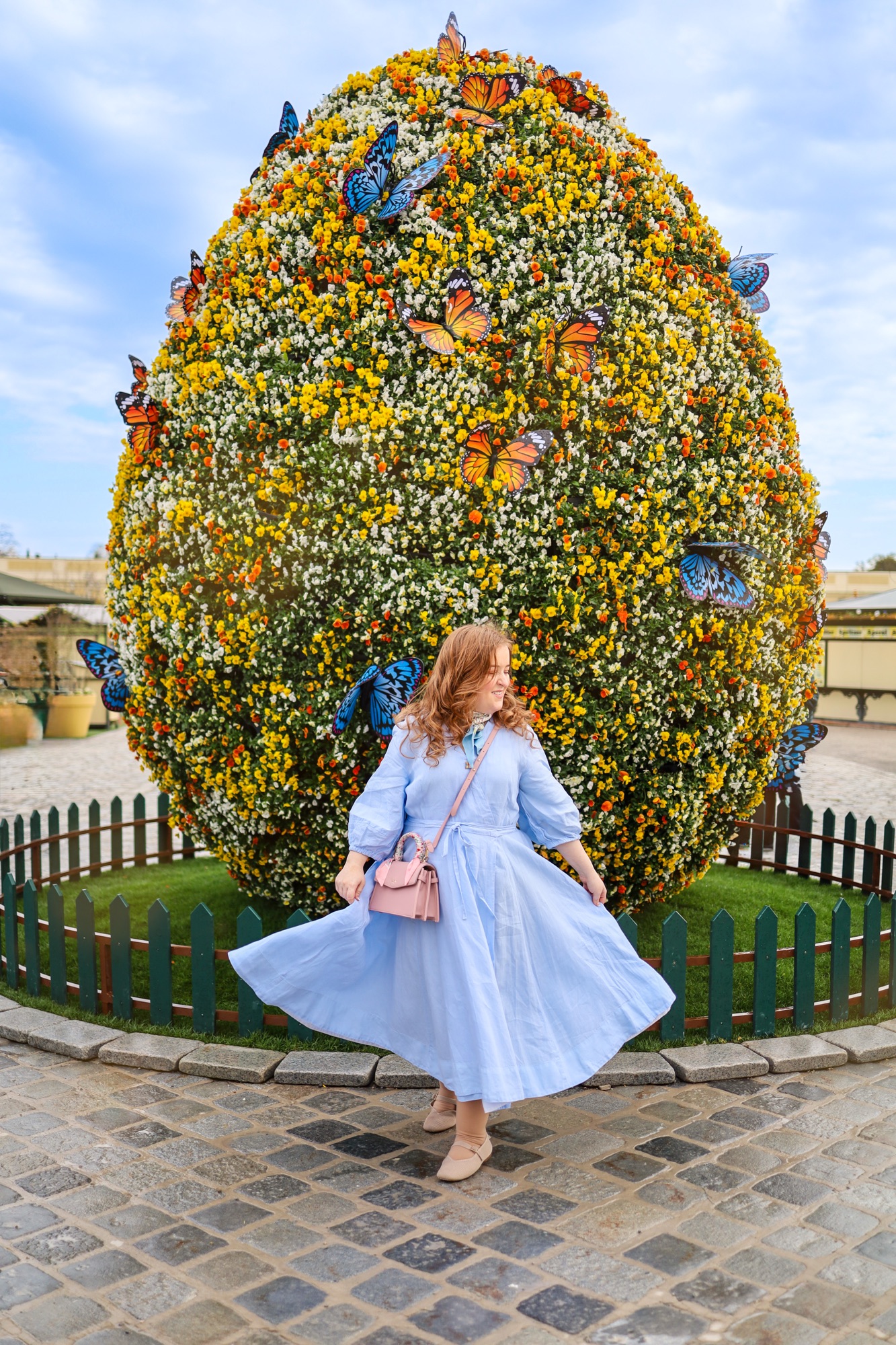
Everyone talks about Vienna’s Christmas markets, but I thought the Easter markets were such a seasonal highlight and a really sensory way to experience the city.

The three best-known Easter markets are Freyung, Am Hof, and the Easter and Spring Market at Schönbrunn Palace.
At Freyung, one of the biggest draws is the huge tower made from around 40,000 painted Easter eggs, along with Easter breads, roast lamb, flowers, handicrafts and live music.


Am Hof focuses on decorated eggs, flower arrangements, crafts and hearty food.
Schönbrunn is especially lovely for its setting, and it also has more family activities such as a straw maze, carousel, Ferris wheel, children’s train and traditional craft workshop.
Best of all, the Easter markets are free to enter.
When I visited in 2026, the Freyung and Am Hof markets ran from 20 March to 6 April, while the Schönbrunn Easter and Spring Market ran from 25 March to 28 April.
Vienna was a wonderful city to experience as a visually impaired traveller.
Between the excellent transport links, the music, the food, the grand historic buildings and the seasonal markets, there was so much to enjoy in a way that felt genuinely sensory.

What stood out most to me was that Vienna did not just feel beautiful in a visual sense.
It felt textured, atmospheric, musical and full of detail in ways that made it exciting to explore. If you are visually impaired and considering a trip, I really do think Vienna is a fantastic option.

Fashioneyesta
Follow along for fashion, travel, beauty, accessibility and lifestyle updates.